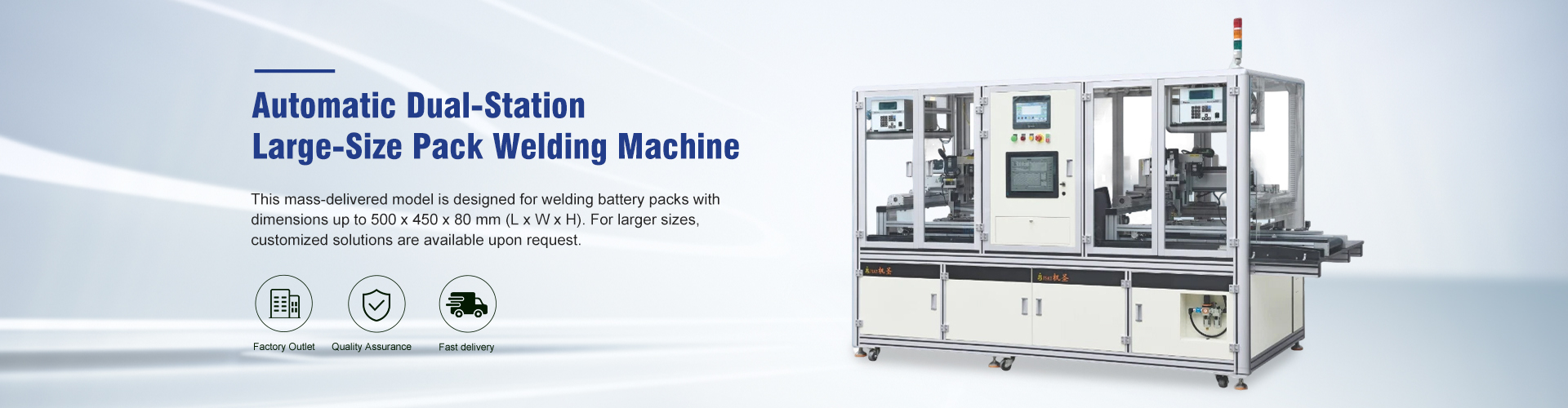
In the welding process of a fully automated high-speed battery pack welding machine, battery overheating damage is a critical issue affecting welding quality and battery safety. If the localized high temperatures generated during welding are not controlled in time, it can lead to oxidation of internal battery materials, electrolyte decomposition, and even battery performance degradation or thermal runaway. Therefore, a comprehensive approach is needed from multiple dimensions, including laser parameter control, cooling system optimization, material compatibility, welding process design, intelligent monitoring technology, equipment maintenance management, and operational procedures, to effectively prevent battery overheating damage.
Precise control of laser parameters is the core element in preventing overheating. Excessive laser power leads to heat concentration in the welding area, exceeding the temperature resistance limit of the battery materials; conversely, excessively slow welding speed results in excessive heat input per unit time, exacerbating localized high temperatures. Therefore, the matching relationship between laser power and welding speed must be scientifically set according to the thermophysical properties, thickness, and welding location of the battery materials. For example, for battery tab materials with low thermal conductivity, the laser power should be appropriately reduced and the welding speed increased to reduce heat accumulation within the material. Simultaneously, using pulsed laser welding technology, by controlling the pulse width and frequency, can further disperse heat input and reduce the size of the heat-affected zone.
Optimized cooling system design is crucial for controlling welding temperature. Fully automated high-speed battery pack welding machines require efficient cooling devices, such as circulating water cooling or air cooling systems, to ensure rapid dissipation of excess heat generated during welding. The cooling system design must consider the flow rate and velocity of the cooling medium, as well as the layout of the cooling channels, to ensure uniform coverage of the welding area and avoid localized insufficient cooling. Furthermore, the selection of the cooling medium must balance thermal conductivity and chemical stability to prevent corrosion or contamination of battery materials. Regular checks of the cooling system's sealing and cleanliness are essential to prevent reduced cooling efficiency due to coolant leaks or blockages.
Material compatibility is a key factor affecting welding temperature. The battery materials being welded (such as tabs, casing, and connectors) must have similar coefficients of thermal expansion and thermal conductivity to reduce localized high temperatures caused by uneven heat conduction. Significant differences in the thermophysical properties of the materials can easily lead to thermal stress concentration during welding, causing battery deformation or cracking. Therefore, rigorous screening and matching of battery materials are necessary before welding to ensure thermal compatibility between the materials at the welding points. For welding dissimilar materials, transition layers or intermediate alloys can be used to reduce thermal stress, or the differences in material properties can be compensated for by adjusting welding process parameters.
Welding process design must balance efficiency and quality. Fully automated high-speed battery pack welding machines typically employ multi-station parallel welding or high-speed continuous welding modes to improve production efficiency. However, high-speed welding can lead to excessively concentrated heat input, increasing the risk of battery overheating. Therefore, it is necessary to distribute heat input and avoid localized overheating by optimizing welding trajectory planning, adjusting welding sequence, or adopting segmented welding processes. For example, for multi-point welding of battery packs, alternating welding methods can be used to allow sufficient time for heat dissipation at welded areas before welding adjacent areas.
The application of intelligent monitoring and feedback control technology enables dynamic management of welding temperature. By installing infrared thermometers or thermocouple sensors in the welding area, welding temperature changes are monitored in real time, and the data is fed back to the control system. When the temperature approaches the temperature limit of the battery materials, the control system automatically adjusts the laser power, welding speed, or cooling medium flow rate to ensure that the welding temperature remains within a safe range. Furthermore, the intelligent monitoring system can record temperature data during the welding process, providing a basis for process optimization and fault diagnosis.
Equipment maintenance and management are fundamental to ensuring stable welding temperatures. Components of a fully automated high-speed battery pack welding machine, such as the laser generator, cooling system, and transmission mechanism, require regular maintenance and calibration to ensure stable performance. For example, cleaning the laser generator's optical path, replacing the cooling system's filters, and lubricating the transmission mechanism can all reduce abnormal welding temperatures caused by equipment malfunctions. Simultaneously, operators must receive professional training and be familiar with equipment operating procedures and emergency response measures to avoid battery overheating due to improper operation.
Strict adherence to operating procedures is the last line of defense against battery overheating damage. Before welding, the battery pack must be pre-treated, such as cleaning the welding surface and removing oxide layers or oil stains, to reduce localized overheating caused by poor contact. During welding, ambient temperature and humidity must be strictly controlled to avoid environmental factors affecting welding quality. After welding, the battery pack must undergo visual inspection and performance testing to ensure there is no overheating damage or welding defects. By establishing comprehensive operating procedures and a quality inspection system, the risk of battery overheating damage can be effectively reduced, improving the reliability and safety of the fully automated high-speed battery pack welding machine.