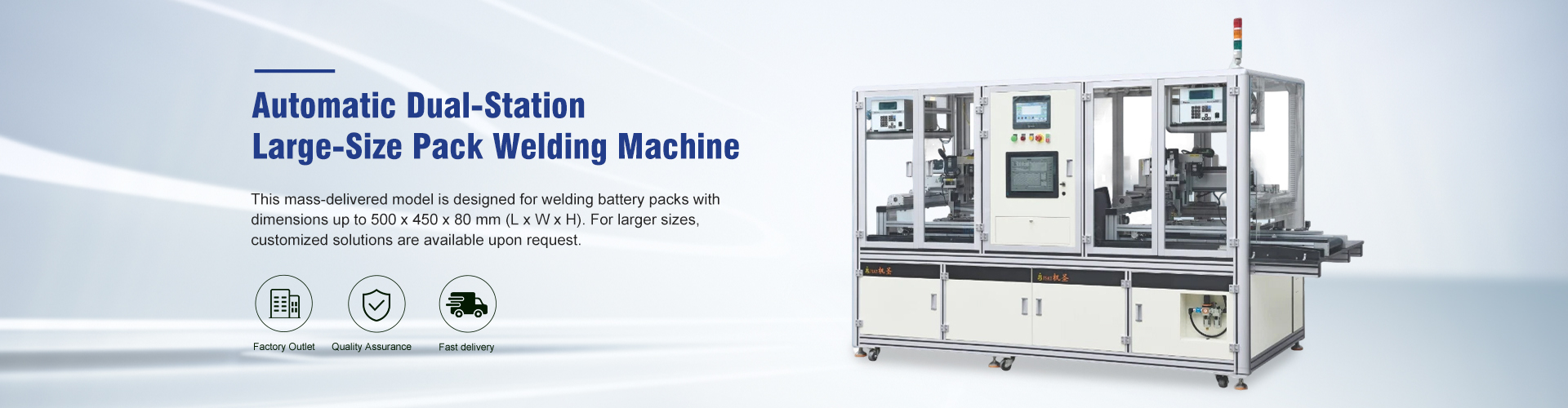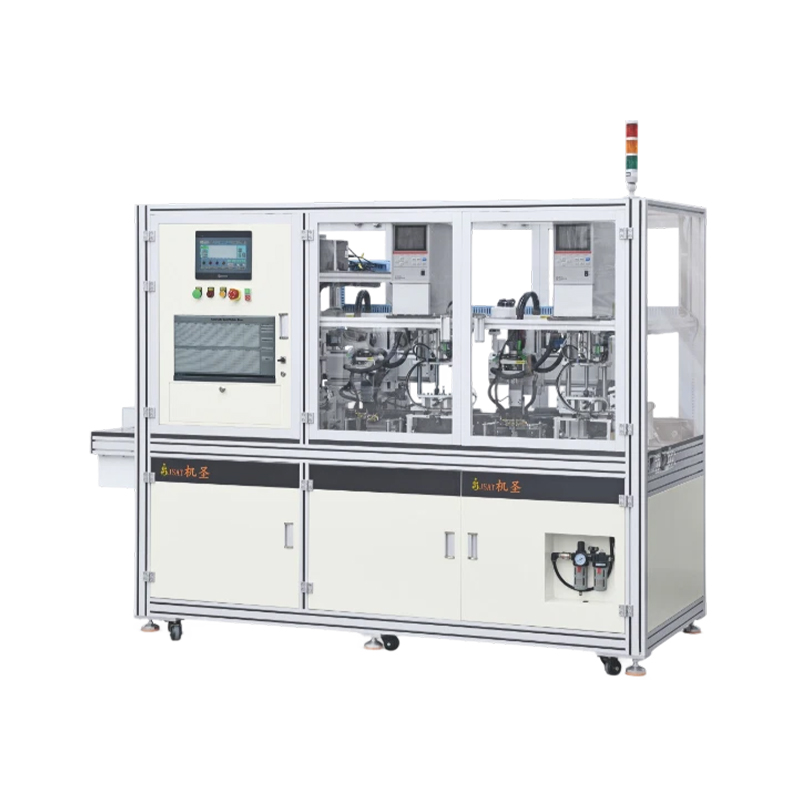
Revolutionizing Welding Technology: The Launch of the Fully Automated High-Speed Battery Pack Welding Machine
Publish Time: 2026-03-30
In today’s rapidly evolving new energy industry, batteries serve as the core power unit. The precision, efficiency, and stability of their manufacturing processes directly determine the performance and market competitiveness of end products. However, within battery pack assembly, the welding process has long been considered a critical bottleneck restricting capacity and quality. Traditional semi-automatic welding methods rely on manual fixture handling and frequent loading and unloading, making it difficult to ensure welding consistency while exposing inefficiency under high-intensity continuous production. Against the backdrop of surging global demand for power batteries, how to break through the automation bottleneck in welding processes and achieve truly unattended high-speed production has become an urgent challenge for many battery manufacturers. Driven by such industrial demands, a revolutionary fully automated high-speed battery pack welding machine has now entered the stage, offering a brand-new solution for battery pack welding with its groundbreaking integrated design and outstanding technical performance.
1. Industry Transformation: How the Welding Process Became a Capacity Bottleneck
1.1 Inherent Limitations of Traditional Welding Methods
In the production process of battery packs, the welding procedure plays a critical role in reliably connecting individual cells through nickel strips or connecting pieces. This step demands extremely high precision in welding position, weld strength, and thermal effect control. However, traditional welding processes are mostly semi-automatic or manual. Operators need to place battery packs into welding fixtures one by one, complete clamping and positioning before welding. After welding, they manually remove the fixture and workpiece, then proceed to clamp the next workpiece. This cycle of “manual clamping – welding – manual removal” appears straightforward, but it conceals multiple issues.
First, manual operation leads to unstable production tact times. Differences in operator skill, reaction speed, and working condition make it difficult to precisely control the processing time for each workpiece, thereby affecting the balance and output planning of the entire production line. Second, repeatable positioning accuracy of fixtures is hard to guarantee. When operators manually place battery packs and lock fixtures, positioning deviations are inevitable—especially after hours of continuous work, fatigue further increases positioning errors, resulting in frequent quality problems such as weld spot shift and cold joints. Moreover, excessive manual intervention requires a large number of operators on the production floor, raising labor costs and bringing additional burdens in personnel management and safety training.
1.2 The Contradiction Between High-Speed Production Demands and Existing Processes
With the continuous expansion of the electric vehicle, energy storage, and high-end consumer electronics markets, battery manufacturers are under unprecedented capacity pressure. A battery pack production line often needs to run at speeds of several weld points per second, with daily outputs reaching tens of thousands of units. Under such high-speed production demands, the shortcomings of traditional semi-automatic welding methods are drastically magnified. Even when companies increase capacity by adding workstations and implementing multiple shifts, fundamental problems such as low fixture turnover efficiency, slow manual operation speed, and fluctuating welding quality remain unresolved. More critically, under prolonged high-intensity operation, operator fatigue and errors significantly raise the defect rate, leading to material waste and increased rework costs. It is fair to say that the welding process has become one of the main bottlenecks restricting the development of battery pack production toward high speed, large scale, and high quality. The industry’s desire for fully automated, unattended welding solutions has never been more urgent.
2. Core Technological Breakthrough: The Innovative Architecture of the Fully Automated High-Speed Battery Pack Welding Machine
To address these industry pain points, the R&D team behind the fully automated high-speed battery pack welding machine (model JS-5) started from first principles, abandoning the conventional approach of “using labor to supplement automation.” Instead, they built a highly integrated, closed-loop automated welding system. The core breakthrough of this equipment lies in deeply integrating an automatic welding fixture recycling function with a high-speed welding system, achieving a fully unattended process that covers fixture clamping, welding operations, fixture release, and recycling for the next cycle.
Although conventional automated welding equipment can automate the welding action to some extent, fixture clamping, release, and return often still rely on manual or semi-automatic auxiliary devices. Fixture turnover efficiency remains low, and continuous cycling is difficult to achieve. The integrated automatic welding fixture recycling system on the JS-5 fully automated high-speed battery pack welding machine fundamentally changes this situation. By combining precision mechanical transmission with intelligent control technology, the system automatically releases the workpiece after completing one welding cycle and quickly returns the empty fixture along a dedicated track to the starting station, ready for the next welding cycle. This entire process requires no manual intervention—all actions including clamping, positioning, tightening, releasing, and returning are performed autonomously by the equipment, enabling truly continuous unattended production.
Specifically, after the battery pack is fed into the welding station, the fixture automatically clamps, ensuring absolute positional stability during welding. Once welding is completed, the fixture automatically releases the finished workpiece, which is then transferred out of the equipment area via a conveying system. Meanwhile, the empty fixture quickly returns along the circulation track to the loading end, waiting for the next battery pack to be loaded. This fixture recycling process runs in parallel with the welding action, consuming no additional production cycle time, allowing the machine to operate continuously at extremely high efficiency. Users can continuously supply battery packs to be welded, and the equipment consistently outputs finished products at a stable tact, achieving true “unmanned operation around the clock.”
2.2 Performance Support from the High-Speed, High-Precision Welding System
While the automated fixture recycling system resolves production tact and manual intervention issues, welding quality and speed are secured by the welding power supply system integrated into the equipment. The JS-5 fully automated high-speed battery pack welding machine is equipped with the industry-renowned Miyachi 8000B series welding power supply, which enjoys an excellent reputation in the field of resistance welding for its stable output characteristics, precise energy control, and outstanding repeatability.
The Miyachi 8000B series welding power supply features high-speed real-time feedback control, capable of dynamically adjusting welding parameters such as current, voltage, and power at the microsecond level. This ensures that each weld spot achieves consistent and reliable quality, even when minor variations occur in material, thickness, or surface condition of the components being welded. This is particularly critical for battery pack welding, because connecting strips are often made of nickel, copper, or composite materials. If the welding power supply cannot compensate for variations between different material batches, issues such as insufficient weld strength or excessive penetration can easily arise.
In terms of welding speed, the equipment achieves a high-speed welding capability of one second per weld point—and this is not just a peak performance value, but a sustained welding speed that the machine can maintain during long-term continuous operation. This means that whether in flexible production with small batches and multiple varieties, or in high-volume mass production of a single type, the JS-5 can deliver the same efficient welding performance. Furthermore, the synergy between high-speed welding and the automatic fixture recycling system enables the equipment to achieve several times the output of traditional semi-automatic machines per unit of time, significantly enhancing overall production line efficiency.
3. Leap in Process Efficiency: Comprehensive Breakthroughs in Unattended Operation, High Quality, and High Reliability
The value of the fully automated high-speed battery pack welding machine lies not only in its improved technical specifications, but also in the systematic process efficiency gains it delivers to battery manufacturers. These gains span production efficiency, quality consistency, operating costs, and production reliability.
3.1 Exponential Improvement in Production Efficiency
Under the traditional semi-automatic welding model, the processing cycle for a single battery pack consists of manual clamping time, welding time, and manual removal time. Manual operations often account for more than half of the total cycle. Even if the welding action itself takes only a few seconds, the inability to significantly compress manual clamping, positioning, and removal stages severely restricts overall output. The JS-5, with its automatic fixture recycling system, reduces manual operation time to nearly zero. The operational tact of the equipment is determined solely by the welding action and the automatic fixture transfer time. As a result, the single-machine capacity increases by multiple times compared with traditional semi-automatic modes.
More importantly, because the equipment operates in an unattended continuous mode, companies no longer need to assign multiple operators to welding stations. There is no concern about production interruptions or efficiency losses caused by shift changes, training, or personnel management. A single JS-5 machine can run continuously for 24 hours a day, requiring only periodic replenishment of battery packs to be welded and routine equipment maintenance. This release of continuous production capability holds immense strategic significance for companies that need to rapidly respond to market orders and maximize capacity utilization.
3.2 Consistency and Stability of Welding Quality
As the core component for energy storage and release, the welding quality of a battery pack directly affects product safety, reliability, and service life. A cold weld or insufficient joint may generate heat, spark, or even cause safety incidents under prolonged vibration or high-current charging and discharging. Therefore, in battery manufacturing, stability of welding quality is far more important than welding speed alone.
The JS-5 fully automated high-speed battery pack welding machine ensures high welding consistency through two core mechanisms. First, the automatic fixture recycling system eliminates positioning deviations caused by manual clamping. For every welding operation, the battery pack is precisely clamped against the same mechanical reference, and the relative position between the welding electrodes and the welding points remains consistent, eliminating weld spot shift caused by positioning errors. Second, the high-precision energy control and real-time feedback compensation of the Miyachi 8000B series welding power supply ensure that every weld receives highly consistent energy input. Even after tens of thousands of consecutive weld spots, the machine maintains stable welding quality, with no degradation due to electrode wear or material fluctuations.
This high stability not only improves product yield but also brings significant quality-cost advantages. Reduced rework rates, fewer after-sales quality issues, and enhanced brand reputation are all long-term returns brought by a high-quality welding process.
3.3 Reliability Enhancement Through Automated Workflow
The level of automation often determines the reliability of a production system under long-term, high-load operation. The JS-5’s design fully considers industrial-grade continuous production scenarios. The automatic fixture recycling system employs durable mechanical structures and reliable sensing control, maintaining long-term stable operation under demanding conditions. The clamping, releasing, and returning actions of the fixture are optimized for smooth motion and precise positioning, minimizing abnormal situations such as jamming or misalignment.
Meanwhile, the electrical control system integrates comprehensive monitoring and self-diagnostic functions, capable of real-time tracking of critical operating status including welding parameters, fixture position, air pressure, and temperature. If an anomaly is detected, the system can promptly issue alarms and take appropriate protective measures to prevent continued production of defective products or equipment damage. This high reliability makes the JS-5 suitable not only for standardized batch production but also for continuous production tasks with extremely high equipment availability requirements.
4. Specifications and Application Scope: Precisely Matching Diverse Production Needs
The value of any advanced equipment ultimately depends on how well it matches actual production requirements. From the outset, the JS-5 fully automated high-speed battery pack welding machine was designed to consider the diverse needs of battery pack manufacturing, with precise targeting in terms of application scope and specifications.
The equipment is suitable for battery packs with dimensions (length × width × height) within the range of 180 × 100 × 80 mm. This range covers typical specifications for power tools, light electric vehicles, energy storage modules, consumer electronic battery packs, and some power battery modules. For battery manufacturers, this means the JS-5 can be widely applied to welding production across multiple product types, offering strong versatility and flexible manufacturing capability.
Regarding the welding power supply, the machine comes standard with the Miyachi 8000B series. This series supports multiple welding modes, allowing flexible configuration of welding parameters based on the material and thickness of the battery pack connecting strips and the specific welding process requirements. Whether nickel strips, nickel-plated steel strips, copper strips, or copper-nickel composite strips, ideal welding results can be achieved through fine parameter adjustments. Additionally, the welding power supply features data communication interfaces, enabling data exchange with manufacturing execution systems (MES). This supports traceability of process parameters and quality monitoring during production, meeting the requirements of modern smart factories for data collection and quality control.
The equipment achieves a welding speed of one second per weld point, with the capability for sustained high-speed operation, fully meeting the cycle time demands of high-volume production scenarios. At the same time, model changeover is designed to be extremely convenient. When switching to a different battery pack specification, operators can quickly adjust the fixture and positioning devices, minimizing changeover time and maximizing overall equipment effectiveness.
5. Moving Toward Smart Manufacturing: The Restructuring Value of Fully Automated Welding Machines for Battery Production Systems
The introduction of the fully automated high-speed battery pack welding machine represents not only a technological upgrade of a single process but also an important step forward for battery production systems toward smart manufacturing. In the context of Industry 4.0 and intelligent manufacturing, battery manufacturers are accelerating the automation, digitalization, and networking of their production processes. As a critical step in battery pack manufacturing, the level of automation in welding directly affects the intelligence level of the entire production line.
The combination of the JS-5’s fully automatic fixture recycling system and high-speed welding capability enables the welding process to seamlessly integrate with upstream and downstream operations. The equipment can be embedded into automated production lines, working in coordination with automatic feeding systems, automatic inspection systems, and automatic packaging systems to form a complete unattended production cell. When the welding process no longer requires human intervention, the entire production line achieves new heights in continuous operation capability, quality consistency, and production efficiency.
From a broader perspective, breakthroughs in welding automation also provide battery manufacturers with opportunities to optimize human resource allocation. Skilled welding technicians can be freed from repetitive, high-intensity manual tasks and redirected toward more valuable activities such as process optimization, equipment maintenance, and quality management. This not only enhances employees’ sense of professional value but also helps companies build a more sustainable talent structure.
Driving Battery Manufacturing to New Heights with Revolutionary Welding Technology
As the new energy industry develops at high speed, every advancement in battery manufacturing processes lays a foundation for safer, more efficient, and more reliable energy applications. The fully automated high-speed battery pack welding machine, with its integrated automatic welding fixture recycling system as the core, combined with the high-performance Miyachi 8000B welding power supply, successfully achieves unattended, continuous, high-speed welding operations. This innovation not only resolves the long-standing pain points of traditional welding methods—low efficiency, quality fluctuations, and high labor dependency—but also provides battery manufacturers with a practical technological pathway to increase capacity, optimize quality, and reduce overall costs.
From technical details to system architecture, from single-machine performance to production line synergy, the JS-5 fully automated high-speed battery pack welding machine demonstrates not only advanced equipment capabilities but also a forward-looking vision for future smart manufacturing. When the welding process transforms from a production bottleneck into an efficiency driver, battery manufacturers will gain a solid manufacturing advantage in intense market competition. It is foreseeable that as such fully automated high-speed welding solutions are widely adopted, the overall process level of battery pack manufacturing will reach new heights, providing even stronger support for the sustainable and healthy development of the new energy industry.