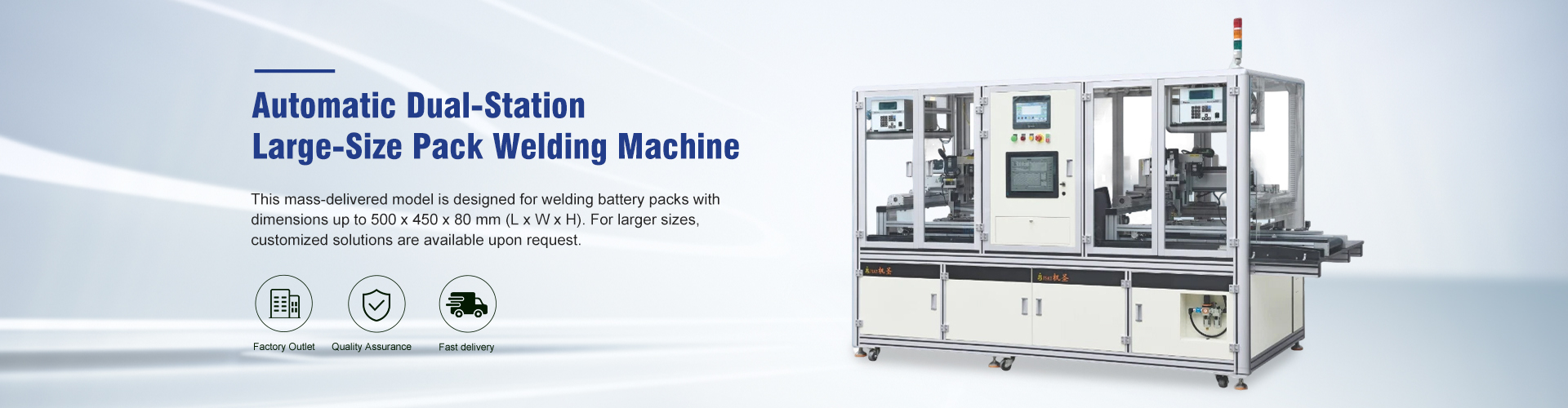
In modern industrial manufacturing, power tools are widely used in construction, home decoration, machinery repair, and many other scenarios due to their convenience and efficiency. As the "heart" of power tools, the degree of automation in the production process of battery packs directly affects product quality, production efficiency, and the competitiveness of enterprises. This article will delve into the key workstations of the automated production line for power tool battery packs.Analysis of Key Workstations in the Automated Production Line for Power Tool Battery Packs(1) Cell SortingAs the core unit of the battery pack, the consistency of its performance has a crucial impact on the stability and lifespan of the entire battery pack. At the cell sorting station, high-precision testing equipment is used to test key parameters such as capacity, internal resistance, and voltage of each cell. Based on the test data, the cells are precisely sorted into different grades according to the differences in performance parameters. For example, cells with similar capacities and consistent internal resistance are grouped into the same batch to ensure a high degree of performance matching among the cells in the subsequently assembled battery pack, thereby reducing local overcharging and over-discharging caused by cell differences, and thus improving the overall performance and lifespan of the battery pack.
(2) Installing the Cells onto the Brackets
The sorted cells need to be precisely installed onto designated brackets to construct the basic structure of the battery module. Automated equipment, utilizing advanced robotic arms and a vision recognition system, can quickly grasp individual battery cells and insert them one by one with extremely high precision according to the preset holes on the brackets. The robotic arm's movements are precisely programmed, ensuring positioning accuracy while strictly controlling the grasping force to avoid physical damage to the battery cells. The vision recognition system monitors the positional relationship between the battery cells and the brackets in real time. If any deviation occurs, the system immediately provides feedback and adjusts the robotic arm's movements to ensure efficient and stable insertion of the battery cells into the brackets.
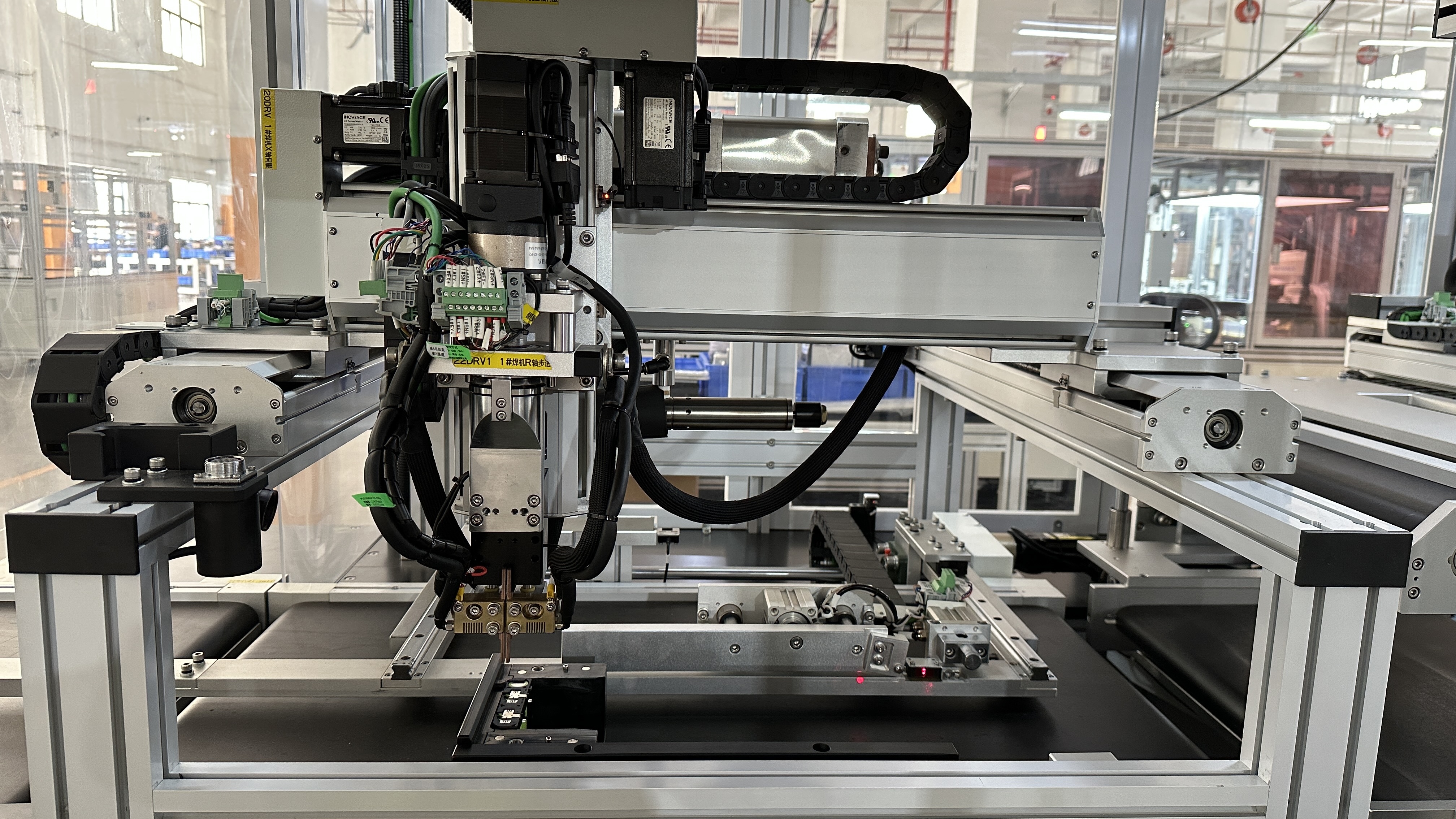
(3) Automated Installation and Welding of Solder Plates into the MoldSolder plates play a crucial role in connecting battery cells and transmitting current within the battery module. The automated equipment at this workstation can automatically select the appropriate solder plate specifications according to the battery pack's design requirements and precisely place them at the connection points of the positive and negative terminals of the battery cells. Subsequently, the equipment moves the entire module, including the solder plates and battery cells, into the mold, preparing it for subsequent welding processes. During this process, automated equipment strictly controls parameters such as the size, material, and placement of the welding pieces to ensure the strength and conductivity of the weld and the stability of current transmission during the charging and discharging of the battery pack.(4) Battery Pack Spot WeldingSpot welding is an important process for firmly connecting battery cells to welding pieces to form a stable circuit connection. Automated spot welding equipment adopts advanced resistance spot welding technology, achieving high-quality welding results by precisely controlling the current magnitude, energizing time, and electrode pressure. During the welding process, the equipment monitors parameters such as welding current and voltage in real time. Once any abnormality is detected, welding immediately stops and an alarm is issued. At the same time, this spot welding equipment has high-speed welding capabilities, which can complete the welding of a large number of battery cells and welding pieces in a short time, greatly improving production efficiency and meeting the needs of large-scale production. For example, some advanced spot welding equipment can complete multiple spot welding operations per second, with stable and reliable welding quality.(5) Automatic Application of NPC AdhesiveNPC adhesive plays an important role in fixing battery cells, enhancing structural stability, and improving the shock resistance of the battery pack. The automated adhesive application equipment is equipped with a high-precision adhesive application control system and a robotic arm, which can precisely control the application position and amount according to the battery pack's structural design. The robotic arm evenly applies NPC adhesive along a preset path to the components requiring fixation, such as cells, brackets, modules, and casings. The adhesive application control system ensures consistent application each time, avoiding product quality issues caused by excessive or insufficient application. After application, the adhesive undergoes a specific curing process (e.g., heat curing, natural curing) to tightly bond with the internal structure of the battery pack, improving overall reliability.(6) BMS InstallationThe Battery Management System (BMS) acts as the "intelligent brain" of the battery pack, monitoring parameters such as voltage, current, and temperature, and implementing functions such as charge/discharge management, overcharge/over-discharge protection, and equalization management. At the BMS installation station, automated equipment precisely installs the pre-tested BMS module into the corresponding position in the battery pack and completes the electrical connection. During installation, the equipment automatically identifies and matches the BMS model and version to ensure compatibility with the battery pack. Simultaneously, an automated testing system is used to conduct preliminary tests on the communication function between the BMS and the battery pack, as well as the accuracy of data acquisition, to ensure the normal operation of the BMS and thus guarantee the safe and stable operation of the battery pack.
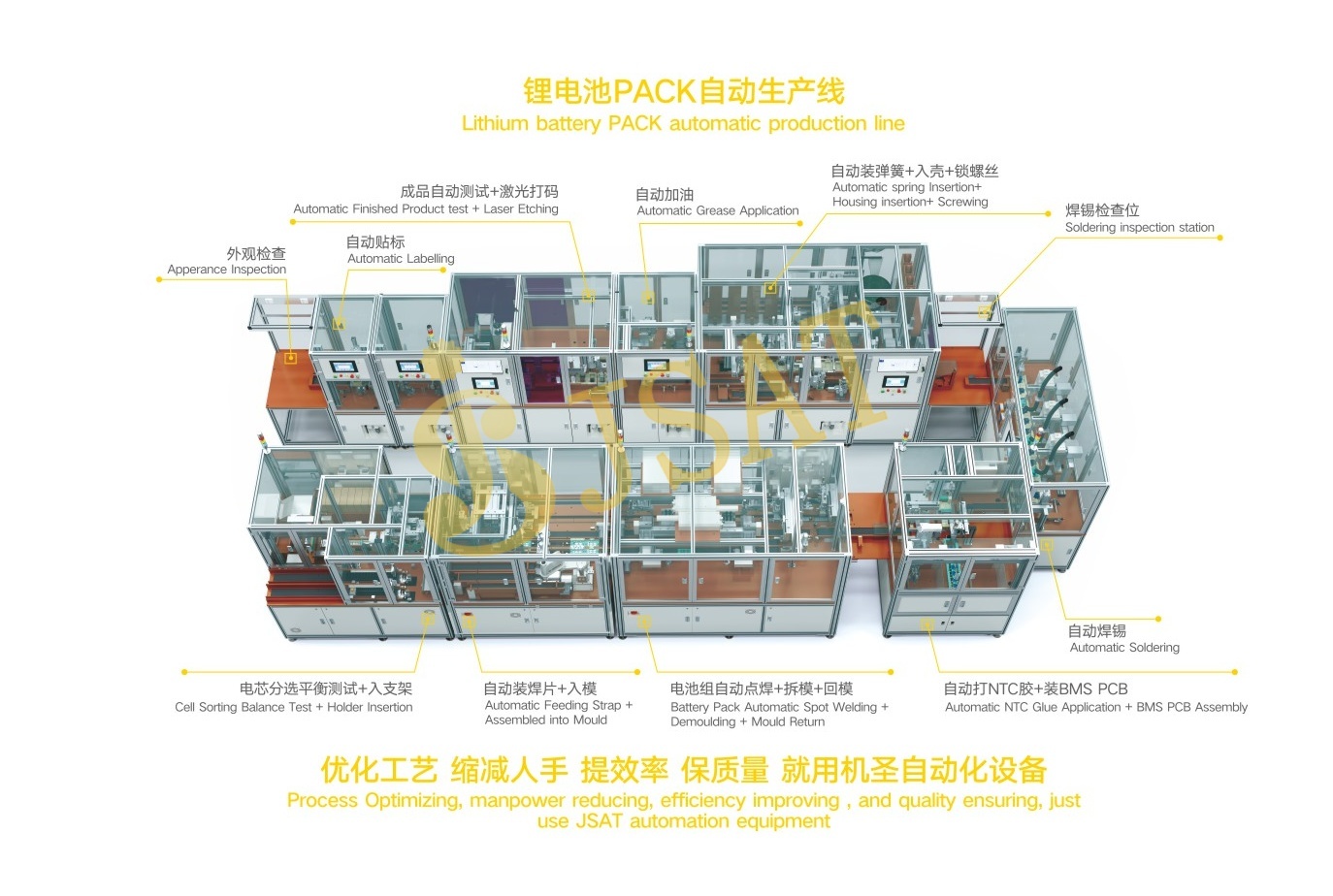
(7) Automated WeldingSome connection lines between the BMS and the battery cells will be welded using an automated welding method. This automated welding equipment is equipped with a precision temperature control system and welding head, enabling precise control of welding temperature and time. During welding, the equipment automatically delivers an appropriate amount of welding wire to the welding area. After the welding head heats up, the welding wire melts, thus achieving a reliable electrical connection. The temperature control system ensures that the welding temperature is always kept within a suitable range, which not only ensures sufficient melting of the solder but also prevents damage to components due to excessive temperature. Compared with traditional manual welding, automated welding has advantages such as stable welding quality, good consistency, and high production efficiency.(8) Comprehensive Testing of Finished ProductsThe assembled and welded battery pack must undergo comprehensive and rigorous testing to ensure that all its performance indicators meet design requirements and industry standards. The comprehensive testing equipment includes a charge/discharge testing system, an internal resistance tester, an insulation performance tester, a temperature cycling test chamber, and other specialized equipment. The charge/discharge test simulates the actual charge/discharge conditions of the battery pack during use, detecting parameters such as capacity, charge/discharge efficiency, and cycle life. Internal resistance testing assesses the resistance of the internal connections within the battery pack to determine if the connections are good. Insulation performance testing ensures that the battery pack will not leak during use, guaranteeing user safety. Temperature cycling testing simulates the battery pack's operation under different ambient temperatures, detecting its performance stability under temperature changes. Only battery packs that pass all tests are deemed qualified products and proceed to the next stage.(9) Automatic Labeling and Visual InspectionBefore the finished battery pack leaves the factory, the automatic labeling equipment accurately affixes labels containing key information such as product model, specifications, production date, production batch number, and QR code to designated locations on the battery pack's outer casing. During labeling, the equipment continuously monitors the label's position and flatness to ensure the labels are firmly attached and clearly legible. In the visual inspection stage, a visual inspection system comprehensively checks the integrity of the battery pack's outer casing, surface flatness, welded area appearance, and label clarity. The system immediately issues an alarm and rejects defective products upon detecting scratches or deformation on the casing, incomplete welds, or blurred markings, ensuring that the appearance quality of finished products meets standards and enhancing brand image.Through precise control of each key workstation, the automated production line for power tool battery packs achieves efficient, precise, and stable production. Against the backdrop of continuously growing global demand for power tools, this production line provides strong support for companies to enhance their competitiveness and expand their market share. In the future, with continuous technological innovation and upgrades, the automated production line for power tool battery packs will develop towards greater intelligence and flexibility, continuously injecting momentum into the prosperous development of the power tool industry.