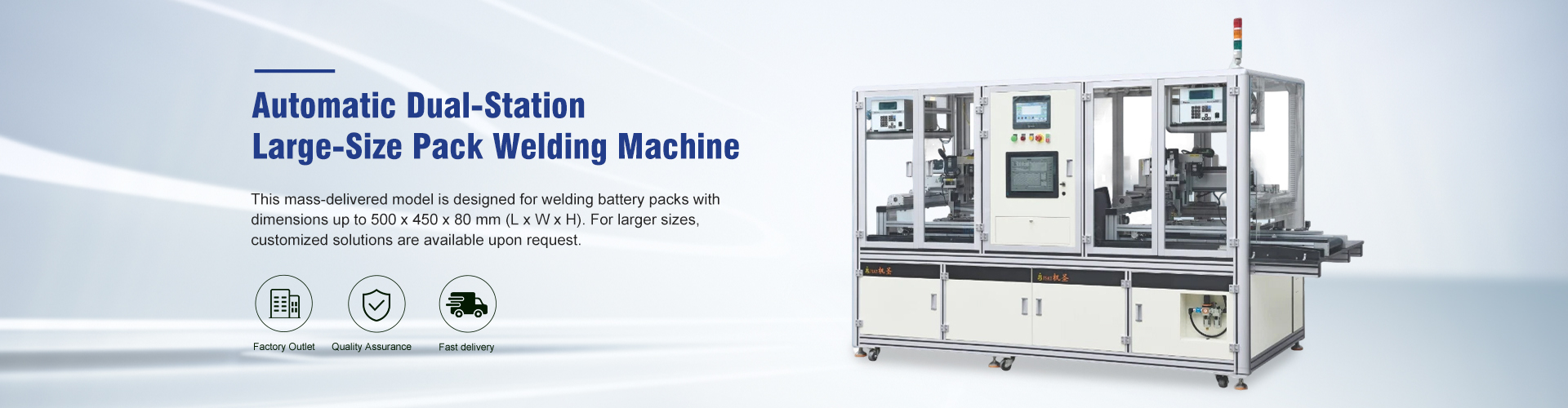
How does the "unlimited welding cycle" of the fully automated high-speed battery pack welding machine achieve this through an automated fixture recycling system, and what is its core technology?
Publish Time: 2026-02-04
Against the backdrop of the rapid development of the new energy vehicle and energy storage industries, large-scale, high-consistency manufacturing of power battery packs has become crucial for industry competition. Among these processes, the welding of busbars or tabs between battery cells is a core step, demanding extremely high speed, precision, and reliability. Traditional semi-automatic welding methods rely on manual loading and unloading, which is not only inefficient but also prone to human error. The fully automated high-speed battery pack welding machine, with its continuously unmanned automated fixture recycling system, achieves a truly "unlimited welding cycle," significantly improving production line cycle time and product consistency. Behind this breakthrough lies the high degree of integration of mechanical, control, and welding technologies.
1. The Logic Behind the "Unlimited Cycle": A Closed-Loop Fixture Flow Mechanism
The so-called "unlimited welding cycle" does not mean that the equipment never wears out, but rather that the system can continuously and automatically complete the entire operation process of "clamping—welding—unloading—fixture reset—reclamping" without human intervention, repeating it indefinitely. Its core lies in the closed-loop design of the automated fixture recycling system: When a set of battery modules is fed into the welding station, a high-precision positioning fixture automatically clamps them; the Gongli 8000B welding machine completes multi-point high-speed welding; after welding, the fixture is released, and a servo-driven conveyor mechanism sends the empty fixture back to the loading end along the track; simultaneously, the next set of modules to be welded is delivered synchronously by the logistics line, achieving "seamless connection". The entire process is uniformly scheduled by a PLC or industrial controller, with a cycle time of 15-30 seconds per piece, truly achieving continuous production with "machines running non-stop and no human intervention".
2. One of the core technologies: High-reliability fixtures and intelligent drive system
The fixture is not only a positioning tool, but also a "carrier" for cyclical circulation. To adapt to high-frequency use, the fixture uses wear-resistant alloy steel or surface-hardened materials, combined with pneumatic/electric clamping units, ensuring a repeatability accuracy of ±0.05mm even after tens of thousands of cycles. The fixture body integrates RFID or QR code tags, which can be automatically identified by the system according to the model and status, preventing misuse. The drive system primarily utilizes a servo motor + precision guide rail structure, offering advantages over traditional cylinders such as controllable speed, precise positioning, and long lifespan, ensuring smooth and shock-free clamping during high-speed reciprocating motion.
3. Core Technology Two: High-Speed, High-Quality Output of the Miyari 8000B Welding Machine
Welding quality is a prerequisite for continuous production. The Miyari 8000B welding machine in this system employs a high-frequency inverter power supply and digital closed-loop control technology, enabling it to respond to impedance changes during the welding process at the microsecond level and dynamically adjust the current waveform to ensure consistent weld nugget size for each weld point. Its multi-channel synchronous welding capability significantly shortens the welding time per piece; combined with low-spatter technology and adaptive pressure control, it achieves high-yield connections even with dissimilar metals like aluminum-copper or coated tabs. More importantly, this welding machine is designed for 24/7 industrial environments, boasting excellent thermal management and protection levels to support long-term stable operation.
4. System Integration and Intelligent Control: Dual Guarantee of Efficiency and Consistency
The "brain" of the entire system is an integrated control platform that coordinates modules such as robots, fixtures, welding machines, and vision inspection to form a unified workflow. Through a pre-set process parameter library, the system can automatically call the welding program for the corresponding product; welding data is collected in real time and uploaded to the MES system, achieving full traceability. If any weld point is abnormal, the system can automatically alarm or reject defective products, avoiding batch defects. This highly integrated automated architecture minimizes downtime while ensuring that every battery pack meets stringent electrical performance and safety standards.
The "unlimited welding cycle" of the fully automated high-speed battery pack welding machine is essentially built through an automated fixture recycling system, creating an efficient, closed-loop, and self-consistent production micro-ecosystem. Its core technology lies not only in the high performance of a single piece of equipment but also in the deep synergy between fixture flow, welding execution, and intelligent control. With the continuous expansion of power battery production capacity, such systems are becoming key tools for improving manufacturing efficiency, ensuring product consistency, and reducing overall costs, providing solid support for the large-scale implementation of green energy.