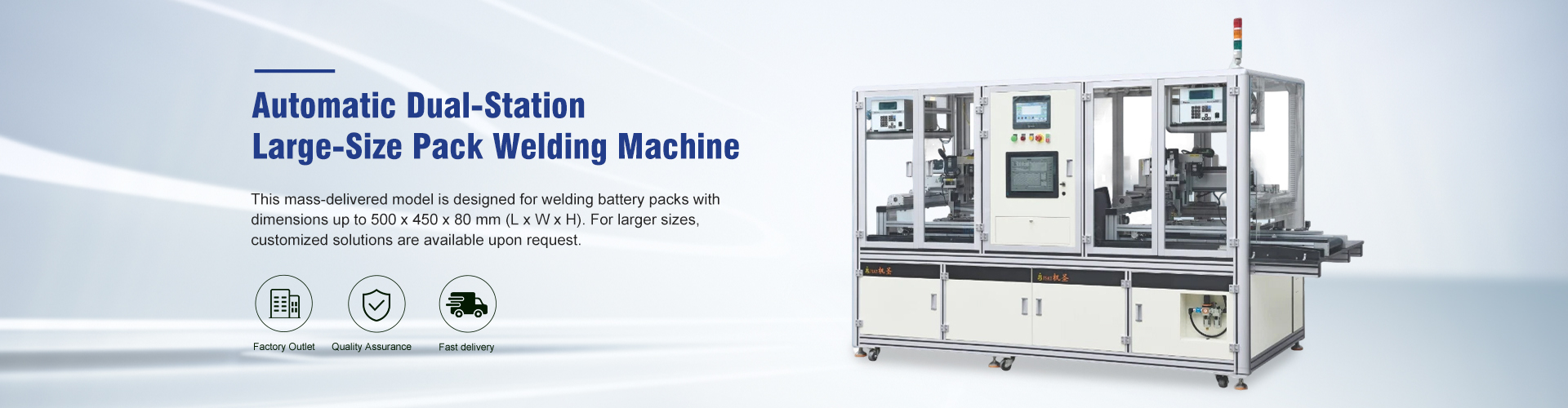
How does the universal automated single-station battery pack welding machine achieve high-speed continuous welding without affecting weld consistency under a single power supply configuration?
Publish Time: 2026-02-18
In the context of the rapid development of the new energy industry, battery packs, as core energy units, are directly related to product safety and performance in terms of manufacturing quality. Among these processes, the welding connection between battery cells is a critical step—it must ensure low-resistance, high-reliability electrical connections while adapting to a diverse range of products and a fast-paced production rhythm. The universal automated single-station battery pack welding machine, with its design concept of "single power supply, single station, high-speed operation," significantly improves efficiency without sacrificing weld consistency. Its core lies in the deep synergy of an intelligent control system, dynamic parameter compensation mechanism, and thermal management strategy, maximizing the potential of a single welding power source.
1. High-Response Digital Welding Control System: The "Brain" of Consistency
The fundamental guarantee of weld consistency stems from the advanced digital welding control system. This system monitors welding current, voltage, pressure, and displacement in real time at a microsecond-level sampling frequency and dynamically adjusts the output energy through closed-loop feedback. Even when faced with interference factors such as variations in the thickness of the oxide layer on the cell surface, batch fluctuations in the tab material, or minor fixture offsets, the controller can adaptively adjust within a single welding cycle, ensuring high consistency in the weld nugget size and contact resistance of each weld point. This "sensing-judgment-correction" capability ensures that a single power supply maintains process stability during continuous operation, avoiding weld quality fluctuations caused by parameter drift in traditional analog power supplies.
2. Electrode Length Monitoring and Automatic Compensation: Eliminating the Influence of Electrode Wear
During high-speed continuous welding, copper electrodes gradually wear down due to high temperatures and friction, leading to increased contact area and decreased current density, which can result in incomplete welds or insufficient penetration. The fully automatic welding machine integrates high-precision displacement sensors and a vision-assisted system to monitor the electrode end face position and wear status in real time. Once a length change exceeding a threshold is detected, the system immediately activates a compensation algorithm: on the one hand, it fine-tunes the slide stroke to maintain constant clamping force; on the other hand, it dynamically increases the welding current or extends the energizing time, precisely offsetting the energy loss caused by electrode passivation. This mechanism ensures that hundreds or even thousands of weld points maintain the same quality level throughout the entire shift.
3. Optimized Single-Station Mechanical Structure: A Balance Between Efficiency and Stability
The single-station design is not simply about "reducing the number of stations," but rather about achieving efficient workflow through a sophisticated mechanical layout. The equipment utilizes a high-rigidity gantry frame and linear motor drive, achieving a positioning repeatability accuracy of ±0.02mm, significantly reducing idle travel time. Simultaneously, the clamping system features rapid self-centering, working in conjunction with pneumatic or servo clamping mechanisms to ensure consistent cell position height after each clamping. More importantly, the single-station design avoids the synchronization errors and maintenance complexity associated with multi-station switching, simplifying the structure while simultaneously improving overall system reliability and providing a stable physical platform for high-speed continuous welding.
Continuous high-frequency welding can easily lead to localized temperature rises, affecting the lifespan of internal components and welding stability. The equipment addresses this through a dual approach: intelligent cycle scheduling and active cooling design. On one hand, the control system automatically inserts microsecond-level cooling intervals based on the welding frequency; on the other hand, the welding head, conductive shaft, and power module are all equipped with air-cooled or liquid-cooled channels to ensure constant temperature for core components. Furthermore, the welding parameter database pre-sets heat input models for different material combinations, preventing metal spatter or tab burn-through caused by overheating, thus ensuring consistent weld morphology from the outset.
In summary, the universal automated single-station battery pack welding machine, through its integrated technology system of "intelligent control + dynamic compensation + structural optimization + thermal management," achieves a balance between high speed and high quality under the constraints of a single power source and single workstation. It not only reduces equipment costs and floor space but also provides a solid foundation for the large-scale, high-quality manufacturing of power batteries with reliable weld consistency—silently building the safety cornerstone of the energy era in every millisecond of discharge.